Why Jaipur belongs in the emerald conversation
An emerald’s story extends beyond its birthplace. Jaipur offers a way to understand the importance of craft and trade.
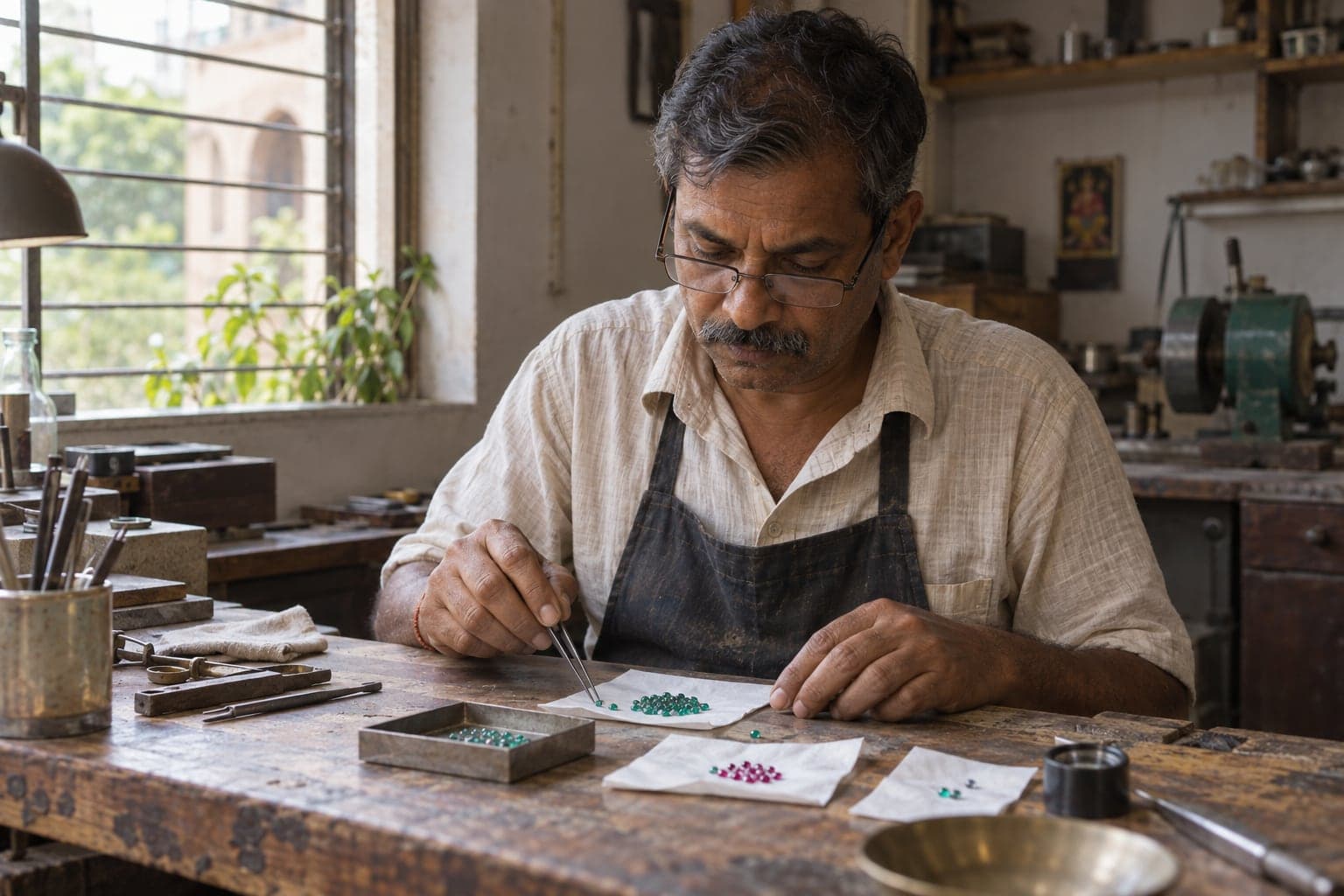
Where a stone began and where it was worked are different parts of its story. Thinking about both opens up a more interesting view of the emerald world, one that includes the people who interpret material as well as the places that produce it.
A city seen through its workshops
GIA’s February 2016 field report on Jaipur, based on a 2015 visit, documents a centre of coloured-stone cutting, trading and jewellery manufacture. It traces the city’s jewellery tradition to its eighteenth-century founding and the invitation of skilled craftspeople. The researchers encountered both traditional working methods and modern facilities. These are historical field observations, not a census of the industry today. GIA’s Jaipur field report.
The report also follows emerald rough from sources including Zambia and Brazil into Jaipur’s workshops. Its interviews show businesses serving different customers and working with different qualities of material. A shared location did not mean an identical business model. GIA’s research on Jaipur’s emerald industry.
Follow the decisions, not just the route
For readers, our suggestion is to approach a trade centre through a few practical questions. Who is choosing the rough? Who is planning the finished piece? Is the intended result a single distinctive stone, a matched pair or a set of consistent sizes for a jewellery design?
These questions shift the emphasis from an impressive place name to the work being discussed. They also give a non-specialist a way to join the conversation. You do not need to know every cutting term to ask what the maker was trying to achieve.
As an exercise, imagine two briefs: a jeweller looking for stones to fit an existing design, and a collector willing to design around one particular emerald. What would you want to ask each of them before discussing material? The point is not to predict their answers. It is to notice how the purpose of an acquisition might change the conversation.
A wider perspective
Brazil is the Club’s specialism, but our interest should not stop at a national border. Jaipur is a valuable subject for study because it encourages us to think about craftsmanship, interpretation and relationships together.
Read the original fieldwork with its date in mind. Enjoy its detail without treating a decade-old observation as a current market statistic or evidence of a Club relationship. That is how a historical account remains useful: as a source of understanding and better questions.