A small world inside an emerald
Under magnification, an emerald becomes a landscape. Its inclusions invite a closer look, not a quick verdict.
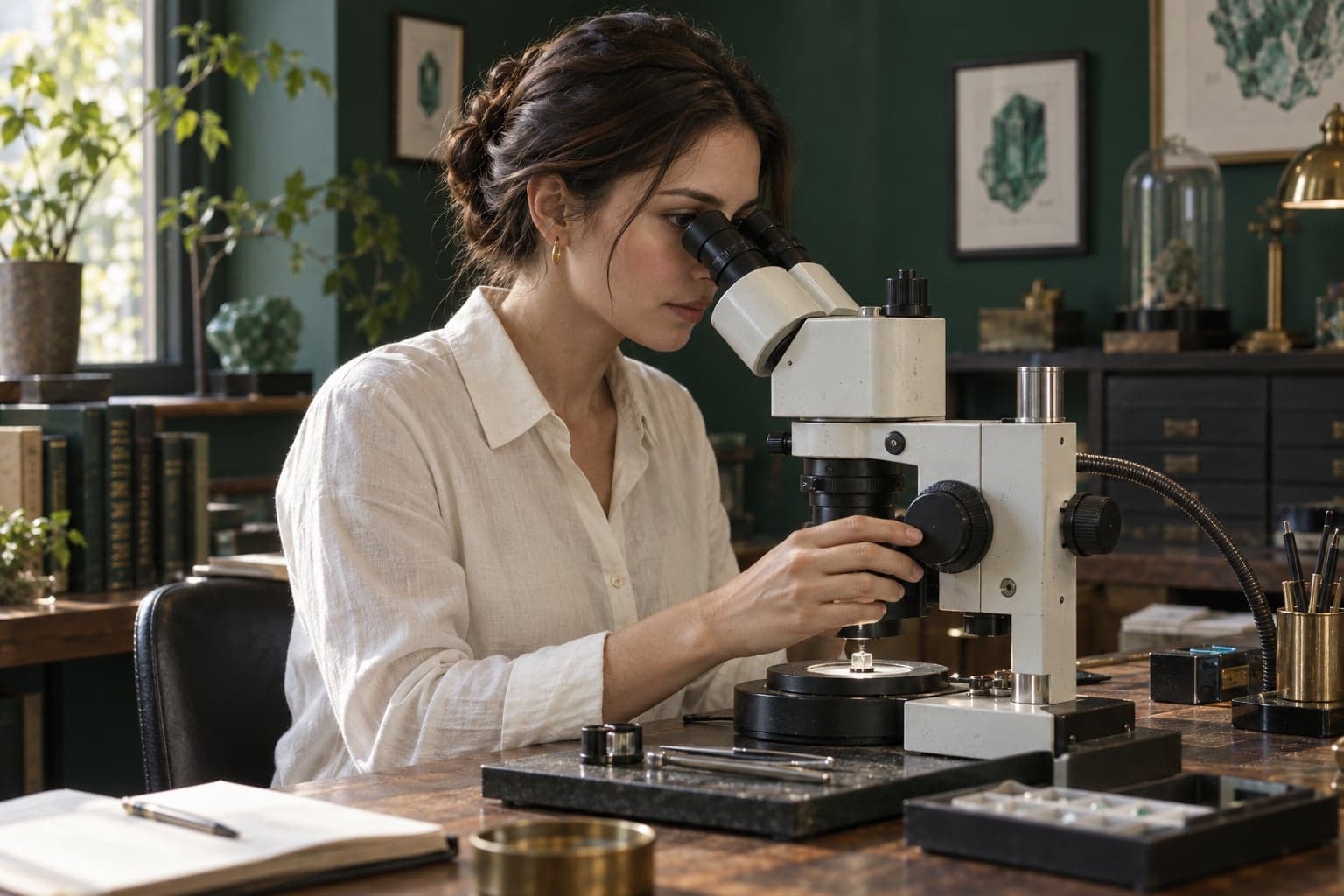
An emerald can hold your attention twice: first through its colour, then through the small world revealed by a closer look. The second encounter asks for patience. What seems like a tiny interruption at first may become the most interesting question in the room.
A landscape under magnification
GIA describes emerald inclusions through the familiar term jardin, meaning garden. Its emerald guide also illustrates a remarkable example of a three-phase inclusion: liquid, a gas bubble and a solid crystal enclosed within a stone. These are microscopic features, not miniature scenes visible in every emerald. GIA’s emerald guide.
Try approaching a magnified image as an observation exercise before treating it as a test. Where is the feature? Does it have a sharp boundary? Is what you are noticing inside the stone, or could it be a reflection? Write down the observation in plain language, then ask a specialist to explain it. There is no advantage in guessing the technical name first.
A clue is not a passport
In a 2014 study, GIA researchers compared emeralds containing three-phase inclusions from several countries. Similar-looking inclusions occurred in material from Colombia, Afghanistan, China and Zambia. Their work combined microscopy with spectroscopy and trace-element analysis to investigate origin. The important lesson is that one attractive microscopic feature does not, on its own, establish a country of origin. GIA’s study of three-phase inclusions.
For a collector, that distinction makes the conversation more rewarding. Instead of asking someone to confirm a conclusion you have already reached, ask what supports their interpretation and what remains uncertain. A good question leaves space for a qualified answer.
Look closely, then step back
Our suggestion is to keep two separate notes during a viewing. One records what you enjoy about the stone at an ordinary viewing distance. The other records questions raised by magnification. Neither needs to become a score.
You might be drawn to a lively green appearance while wanting clarification about a particular internal feature. Those reactions can coexist. Appreciation need not depend on pretending that everything is understood, and curiosity need not turn every detail into a defect.
The aim is not to become a laboratory in an afternoon. It is to leave with a more precise question than the one you arrived with.